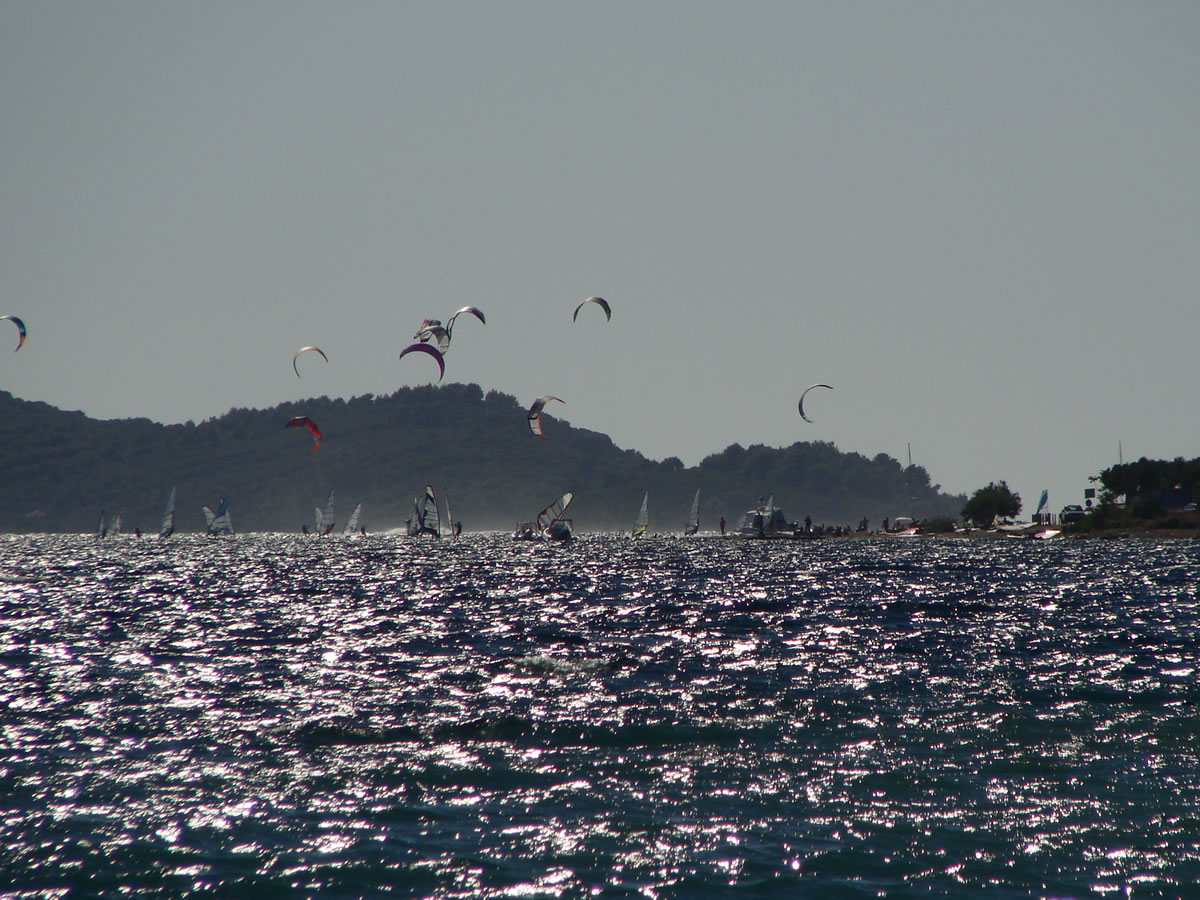
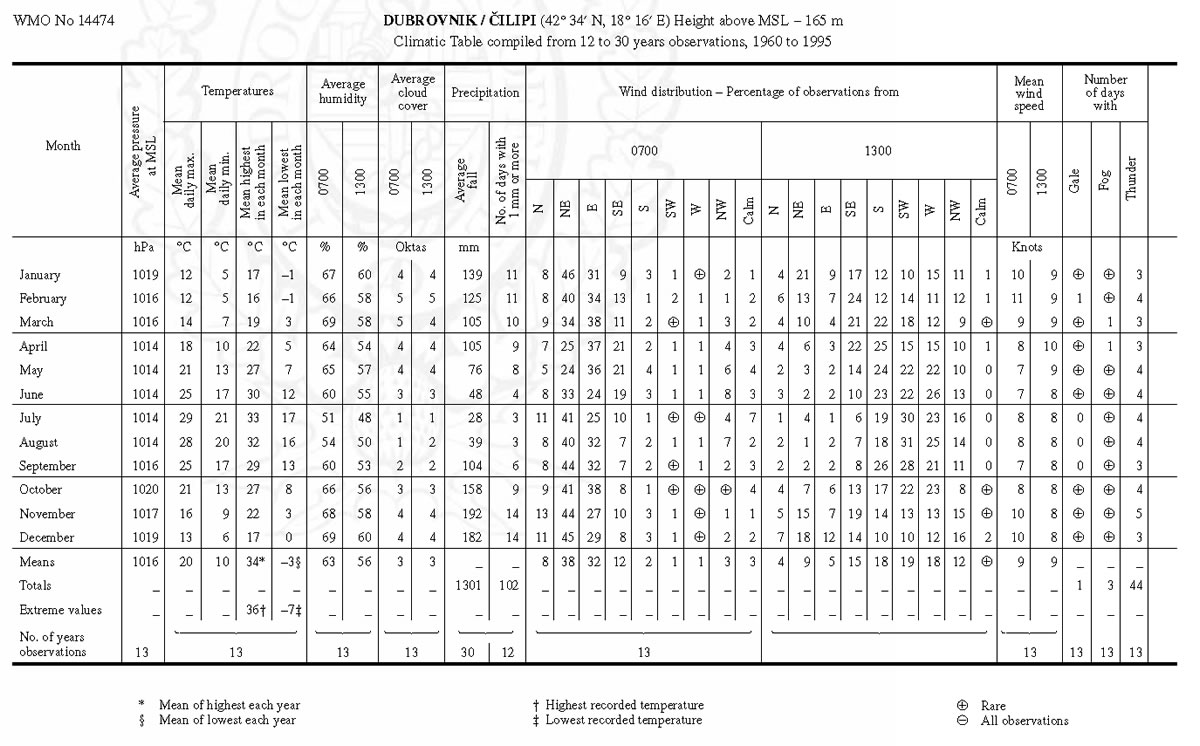
Slalom board (+120 liters) and sail of +8.0 square meter will allow you to sail almost every day. Very often in the late summer, Maestral begin to blow later (at around 15:00-16:00), reaching maximum force of 4 Bf at around 18:00 and diminishing at around 20:00. Such Maestral is liable to blow in 10 to 15 days-spells.
The most popular kit set up for a "standard Maestral days" (5-6 Bf in May, June and July) is freeride, freestyle or freemove board from 100 to 110 liters with a sail range from 6 to 6.5 square meters.
Third, smaller kit (wave or freestyle board <95lit and sail <5.5 sq.meters) can be used on a several big days during the summer and more often in October and November (Jugo).
Above equipment is recommended for the average weight windsurfer (75-85 kg).
::Water Temperature and Wetsuit Guide
The water temperature – wetsuit thickness chart below is just for your orientation and is a bit on the safe side, so you can stay in the water longer.
Month
Water TemperatureAir temperature
Recommendedwetsuit
Remarks
July and August
23-25°c24-26°c
Board shorts +lycra or neoprene(2/1 mm) T-shirt
Shorty can be used in a windy days.
June and September
21-23°c22-24°c
Shorty (2-2.5mm)
For windy days in begining of June steamer 3/2 is recommended.
October
17-19°c17-18°c
Semidry (3/2 mm)
Steamer 3/2 still can be used.
May
16-18°c17-18°c
Semidry (3/2 mm) + boots or Semidry (4/3 mm)
N/A
November
16-17°c13-14°c
Semidry (3/2 mm) + boots or Semidry (4/3 mm)
N/A
April
14-15°c14-15°c
Semidry (4/3 mm)+boots
N/A
December, January, February and March
13-15°c9-14°c
Semidry (5/3 mm)+ boots
Optionally gloves and hood.
* Wearing of Personal Flotation Devices (PFDs) is not mandatory, but it's strongly recommended.
* Also beware of sea urchins, which are relatively common on the seagrass or rocky seabed. Windsurfing shoes are recommended throughout the year.
* The most versatile wetsuit for this area is steamer with removable sleeves. It can be used almost all spring and autmn.
::Safety
Peljesac Channel is a very safe place to windsurf thanks to weak currents, small tidal range and channel topography. Channel seabed is clear of obstructions.
Particular dangers in the channel to be aware of are: dense marine traffic (sailing boats, yachts, cruise ships, ferries etc.) including hundreds of windsurfers and kitesurfers during the summer, sudden offshore wind and westerly storms (for details, please section winds).
Poor visibility due to fog is rare on the average of less than 1 day a year. Visibility may be reduced in rain showers. Shark sightings have never been reported in this area.
Currents are frequently W-going in Peljesac Channel, except near Korcula, at a rate of about 1 knot, but in W winds stronger E-going current is established.
Tidal streams; In calm weather and light winds the E and W-going tidal streams change with the tide, attaining a rate of 0.5 to 1.5 knots.
The tidal range (the vertical difference between the high tide and the succeeding low tide) is up to 0.5 meter.
::Adriatic Sea: Climate and Weather - general conditions
There is a very marked seasonal variation in all parts of the region. A warm or hot season from June to September contrasts with a cool season from November to April whilst October and May can be regarded as transitional months. The period between June and September is normally hot and dry with light winds in the S and central parts of the region. In the N of the area thundery spells bring rain in the summer months and although this period is not free from strong winds the incidence is low and duration is usually brief. The winter is by comparison cool and wet although it is only in the N and inland in the E where very low temperatures can be expected.
Strong winds are not uncommon in all areas and it is in winter that the most violent and prolonged gales of the Bora type occur in the Adriatic. Fog is most frequent over the cold waters of the N Adriatic in this season, particularly with S winds but elsewhere the incidence of fog is low. Prolonged periods of fine settled weather are common particularly in the S and central parts, but on occasions, especially at the end of the warm season and in winter, the weather may rapidly deteriorate and give way to dangerous and violent conditions with little warning.
Source: MEDITERRANEAN PILOT, VOLUME III (UK HYDROGRAPHIC OFFICE)
::CROSurf Windsurfing Links
::Emergency contacts
Search and Rescue at sea -
MRCC-Rijeka: 24/7 toll-free telephone number: 195
Port Authority Orebic (08.00 - 20.00): +385 20 714 069
Port Authority Korcula (07.00 - 22.00) +385 20 711 178